At dusk, the medieval village goes quiet in that pre-storm way, like the world is holding its breath.
Then it arrives: a black cyclone of crows, swirling overhead, cawing like a jury that already reached a verdict.
Somebody whispers morte without realizing they said it out loud. Somebody else counts them. And when a neighbor falls ill a week later, the story clicks into place with the satisfaction of a locked door:
The birds warned us.
Fast-forward to 2026. Same animal brain. Different clothing.
A coworker “orbits” your work. They drop a cryptic Slack note. They just happen to show up in the meeting where your project gets questioned. Then your deadline slips, and suddenly your brain doesn’t see a teammate.
It sees a beak.
Not because you’re irrational. Because you’re human.
We are myth machines with calendars.
The new omen: a mandatory meeting… days away
The invite hits your calendar like a cold pebble down the collar.
Then you re-open it and it lands again, like a black feather on your keyboard.
Mandatory meeting Required attendance Three days from now No agenda. No context. No mercy.
And that’s the trick. Not the meeting, the waiting.
Humans don’t fear events. We fear uncertainty with a countdown.
By lunch, the office splits into tribes:
The Doom Choir: “This is the we’re all fired meeting.” (They laugh while their stomach drops.)
The Hopeful Accountants: “Probably nothing. Routine.” (Mundane words as flotation devices.)
The Cryptics: the ones who “know,” or perform knowing. “Just… be on time.” “Don’t stress.” “You’ll see.”
Which is what you say when you want status without accountability.
And you, because you have a nervous system, start doing what villagers have always done under a dark sky:
You start counting signs.
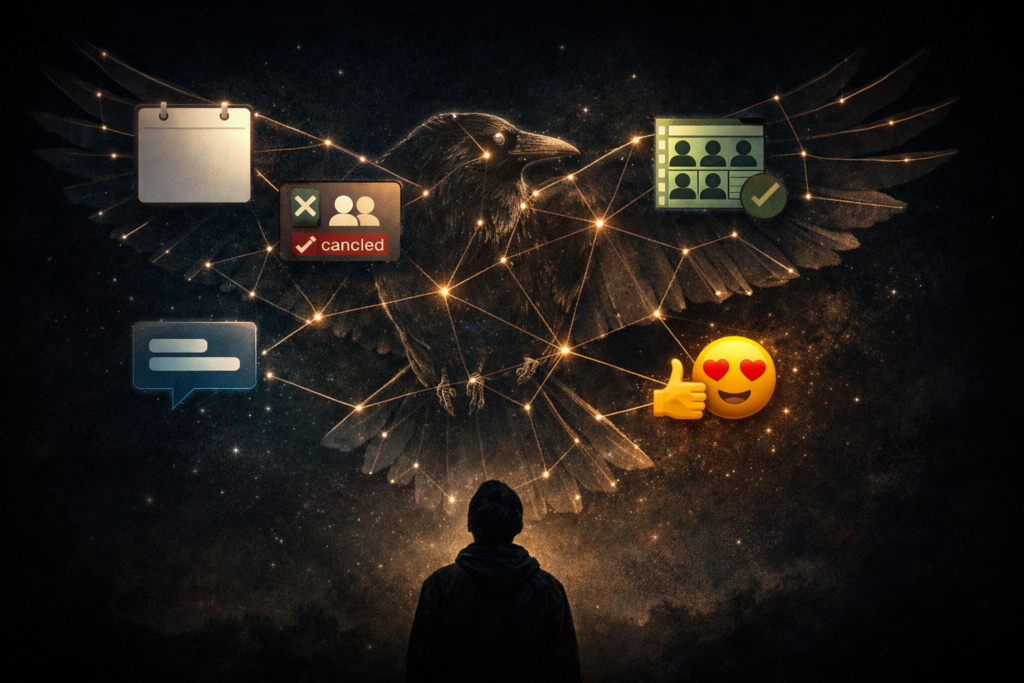
A director cancels a 1:1. Finance asks for updated headcount “just to reconcile.” A VP posts “Grateful for this team” on LinkedIn like it’s a eulogy.
None of it is proof. But proof isn’t the job your brain is hiring for.
Because last time? Last time a mandatory meeting appeared like this, vague, days out, unavoidable, it was the end.
So now the meeting isn’t a meeting. It’s a prophecy.
The leadership tell: a calendar invite is a culture test 🧪
Here’s the part leaders miss: a vague mandatory meeting is a trust litmus test.
In a high-trust workplace, people assume it’s important. In a low-trust one, they assume it’s fatal.
The panic isn’t overreacting. It’s history talking.
A calendar invite doesn’t create fear. It reveals how much fear is already there.
Trust is what fills the empty agenda.
Apophenia: the ancient blueprint with a new costume 🧠
Your brain evolved to spot meaning in noise because the cost of a false alarm was low compared to the cost of being lunch.
Rustle in the grass? Assume tiger. Live longer.
That same wiring still runs in the background, only now it’s scanning:
meeting invites
emojis
tone in a “quick question” message
the order your boss replied in the thread
There’s a word for it: apophenia (ah-puh-FEE-nee-uh), the habit of seeing meaningful connections between unrelated events.
Helpful in the jungle. Messy in a modern org chart.
Crows aren’t prophets. They’re strategists. (And so are we.) 🐦⬛
Here’s the twist: crows really do “circle” for reasons that look spooky if you don’t know the rules.
They gather. They call. They swarm perceived threats. They move as a group.
Not fate. Risk management.
The medieval villager saw omens. The crow saw: predator near the nest, call the squad.
Now swap “nest” for “project,” and you get the office misread:
You interpret attention as threat.
You interpret silence as plotting.
You interpret coincidence as coordination.
That’s crow math: stacking tiny signals until they feel like certainty.
Modern office murders: how neutral people become villains 🔥
Once the story forms, your brain becomes an unpaid intern for the prosecution. It goes hunting for proof.
A vague LinkedIn post? Must be about you. Skipped happy hour? Cold war. One eye-roll? Coup attempt.
This is where the workplace gets haunted: not by enemies, but by interpretations.
And once your brain has a villain, it can stop doing the harder work of uncertainty:
Maybe the scope was unclear.
Maybe the market shifted.
Maybe we didn’t align early.
Maybe that coworker is… just quiet.
Sometimes a poker face is just… a face.
(And sometimes the cryptic coworker isn’t a crow. They’re just a person who writes like a fortune cookie.)
If you want a rule that won’t get you fired for quoting it, here’s the office-safe version of Hanlon’s Razor:
Assume confusion before conspiracy. Or simpler: Don’t mistake clumsiness for malice.
Everyday crow logic (when we assign outcomes to omens) 🧩
Apophenia isn’t only paranoia. It shows up in the cute stuff too.
1) Rituals disguised as reason
Lucky socks. Pre-demo routines. The “I always do this before presentations” superstition. Pattern-making as comfort.
2) Social misreads
Quiet new hire = schemer. Brief leader = angry. Sometimes… it’s just Tuesday.
3) Spreadsheet astrology
Revenue dips and someone half-jokes about cosmic forces, then starts acting like it’s real. Meaning is easier than measurement.
A red-team check: what if you’re wrong? 🎯
Let’s be politely brutal.
If your Crow-woker story is wrong, the cost is real:
you burn trust
you start managing shadows
you miss the boring truth (scope, incentives, capacity)
you become the person others tiptoe around
And if your story is right? You still need evidence, not vibes, because acting on dread without proof turns you into the instability.
Rule of thumb: treat suspicion like a draft, not a diagnosis.
The counter-spell: three moves to break the myth loop 🕯️
1) Name the story (privately)
Write it in one sentence:
“They’re circling my work because they want me to fail.”
Now write three alternatives that are boring but plausible:
They’re anxious about visibility.
They don’t understand the scope.
They communicate like an Excel sheet.
Boring is often closer to true.
2) Swap mind-reading for a testable question
Instead of: “Why are you doing this to me?” Try: “What part feels risky to you right now?” Uncertainty can’t survive a flashlight.
3) Audit the system, not just the person
If your org runs on unclear ownership, shifting priorities, vague success metrics, or incentives that pit people against each other, paranoia isn’t a personal flaw.
It’s a predictable output.
RGQs worth sitting with ☕🕵️♂️
What “crow” am I treating like an omen when it might just be information?
Where am I confusing correlation with coordination?
If I’m wrong about this person, what would I regret doing this week?
What ambiguity in our process is inviting people to invent stories?
If this “mandatory meeting” scares everyone, what does that say about our trust balance?
Don’t count the birds. Check the nest. 🪺
The medieval villagers weren’t stupid. They were doing what humans do: building meaning fast enough to feel safe.
So are we.
But the next time a mandatory meeting appears with days of runway, don’t just stare at the sky and whisper doom. Walk back into the village. Look at the systems. Ask what’s actually threatened.
Then decide whether you’re seeing prophecy…
…or just crows doing crow math.
So the next time your calendar drops a blank, mandatory block like a dark feather, remember: the invite isn’t always the danger. The danger is what your brain builds in the silence between now and then.
This investigation is part of The Deductionists, a league of sharp minds unraveling the peculiar and the personal. Because if we don’t question it, who will?
🎙 Want more investigations like this? Listen to The Deductionists Podcast and subscribe so you don’t miss the next case file: Spotify: https://open.spotify.com/show/3bCKQalXRjvAzulOiAX5Zj Apple Podcasts: https://podcasts.apple.com/us/podcast/the-deductionists/id1797598400 Website: https://www.thedeductionists.com/
CTA: If you’ve ever had a “mandatory meeting” invite hijack your entire nervous system, drop your favorite “sign you started counting” (emoji reactions welcome). I’m collecting the modern omens. 🐦⬛